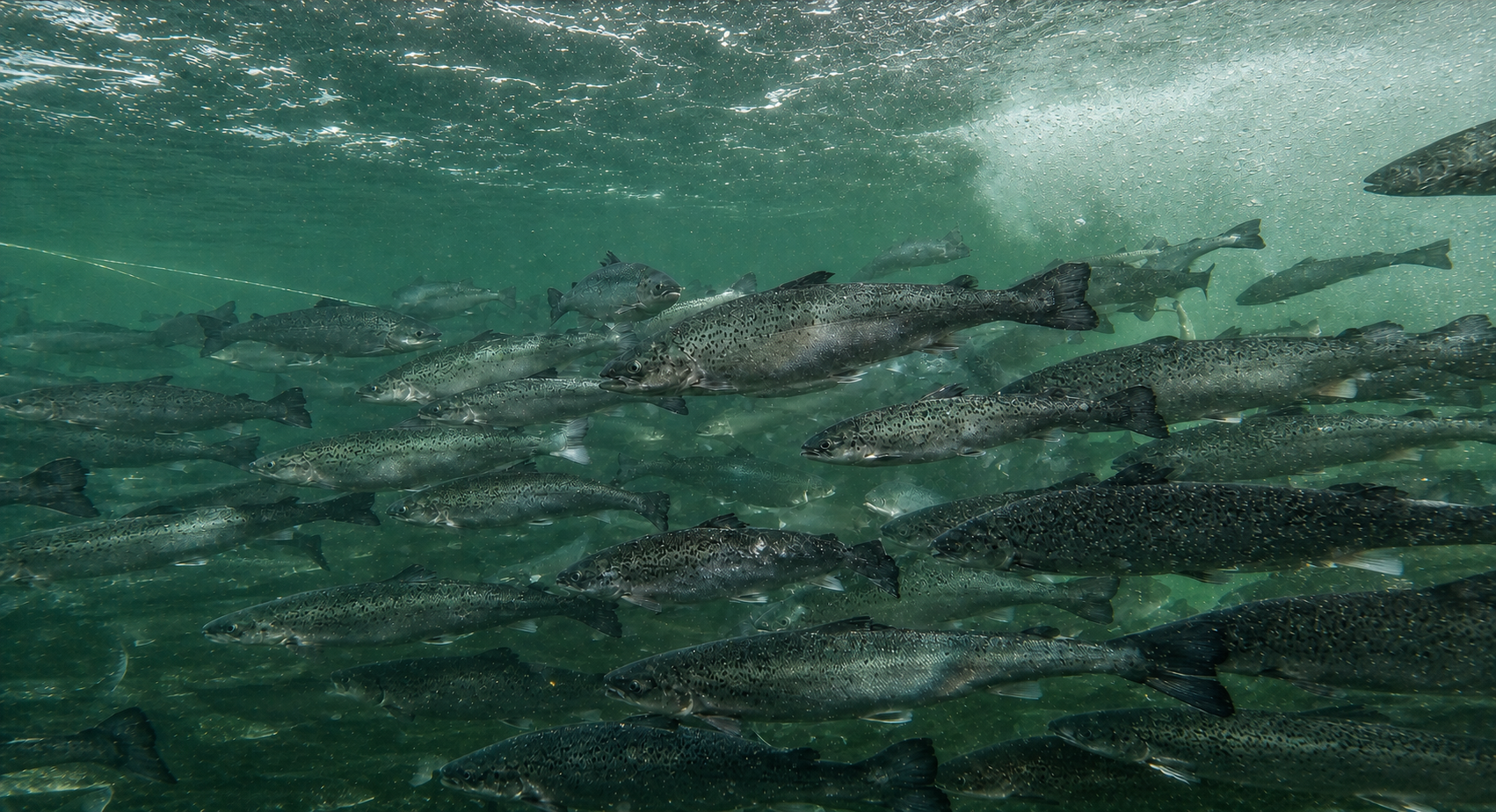
Dr Adam Brooker introduces the Airlectric Project
Maintaining adequate dissolved oxygen in salmon net-pens is a persistent operational challenge. Whether driven by algal blooms, elevated water temperatures, gill disease pressure or the physiological stress of routine treatments, low oxygen events compromise fish health, welfare and performance. The industry's standard solution is centralised diesel or electric compressor aeration, which is expensive and unresponsive to changes in water quality that can drop rapidly, leaving fish to cope with suboptimal conditions.
The Airlectric project, a BBSRC-funded collaboration between the University of Stirling's Institute of Aquaculture, Pneuma International Ltd and Bakkafrost Scotland, evaluated whether precision electric aeration can do better.
Video: Dr Adam Brooker and Dr Wesley Malcorps introduce the Airlectric Project
The Pneuma System
Pneuma is a compact, self-contained single-phase electric aeration unit mounted directly on individual net pen handrails, replacing the extensive pipe network with a decentralised, pen-level approach with a short, direct hose between the compressor and diffuser. The unit can operate continuously or trigger automatically via dissolved oxygen and chlorophyll thresholds, with live data accessible remotely through a cloud-connected platform. Its lower operating costs mean it can be used as required throughout the production cycle, not just during critical events, and its compatibility with renewable energy sources makes it a potential component of broader decarbonisation strategies.
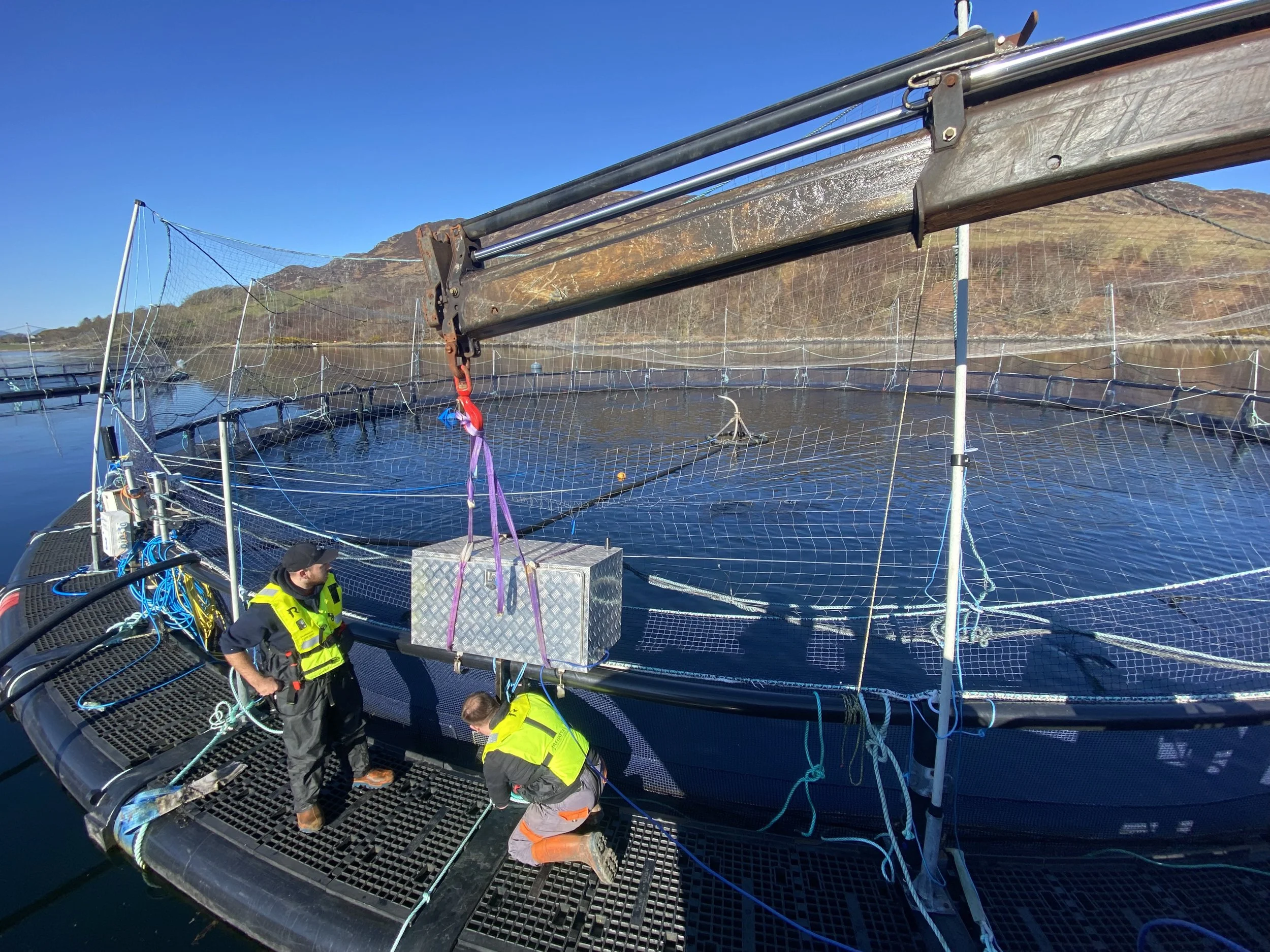
Fixing the Pneuma system to the cage handrail
Trial Design
In Trial 1, system performance benchmarking directly compared two aeration configurations: a Pneuma unit running continuously and a centralised diesel compressor running continuously. Dissolved oxygen, temperature, salinity and chlorophyll were monitored continuously at multiple depths and positions within each pen, with power consumption logged for Pneuma units and fuel usage manually recorded for the diesel compressor.
The performance data were striking. Scaled to a full 12-pen site, Pneuma was more than ten times more efficient per litre of air delivered in terms of energy usage. The operational cost advantage was equally clear with Pneuma costing 75% less than diesel aeration and producing 0.51 kg CO₂ equivalent compared to 7.01 kg CO₂ equivalent for diesel aeration, which is a 14-fold reduction in emissions intensity.
A full life-cycle assessment (LCA) placed these gains in the context of whole-farm environmental impact. While the switch from centralised to Pneuma aeration produces a meaningful reduction in aeration-specific emissions, the LCA contribution analysis confirmed that feed dominates the farm's overall environmental footprint across almost all impact categories and accounts for around 89% of total climate change impact. This finding underscores an important secondary benefit of improved aeration: better water quality and fish welfare supports feed uptake and reduces FCR, and it is through this pathway that precision aeration can have its most significant effect on the overall environmental footprint of salmon production.
In Trial 2, which investigated the impact of precision aeration on fish health, welfare and performance, six net pens were monitored for 8 months, with three pens assigned to on-demand Pneuma aeration and three to standard centralised compressor aeration as the control. The same water quality monitoring framework as Trial 1 was deployed with the addition of:
Fish health and welfare farm records
Production performance farm records
Chronic stress assessed from scale cortisol providing a physiological measure of cumulative stress over time
Analysis of Trial 2 data is ongoing, with results to be presented at Aquaculture Europe 2026. However, early results show that smart control improves aeration efficiency even further and may improve welfare outcomes.
Outlook
The trial represents the first rigorous commercial-scale evaluation of sensor-triggered, pen-level electric aeration in salmon production. If the data support the hypothesis that consistent, responsive aeration improves water quality profiles and downstream fish health and performance outcomes, the case for industry-wide adoption will be strong, particularly as the sector accelerates electrification and moves towards measurable Scope 1 emissions reductions under ASC and other certification frameworks.
Beyond salmon, the technology has clear potential in tropical shrimp aquaculture, where dissolved oxygen limitation is a primary constraint on intensification and where low-cost, solar-compatible aeration could be genuinely transformative.
The Airlectric project is funded by a BBSRC Sustainable Aquaculture Partnerships for Innovation award and delivered in collaboration between the University of Stirling, Pneuma International Ltd and Bakkafrost Scotland.